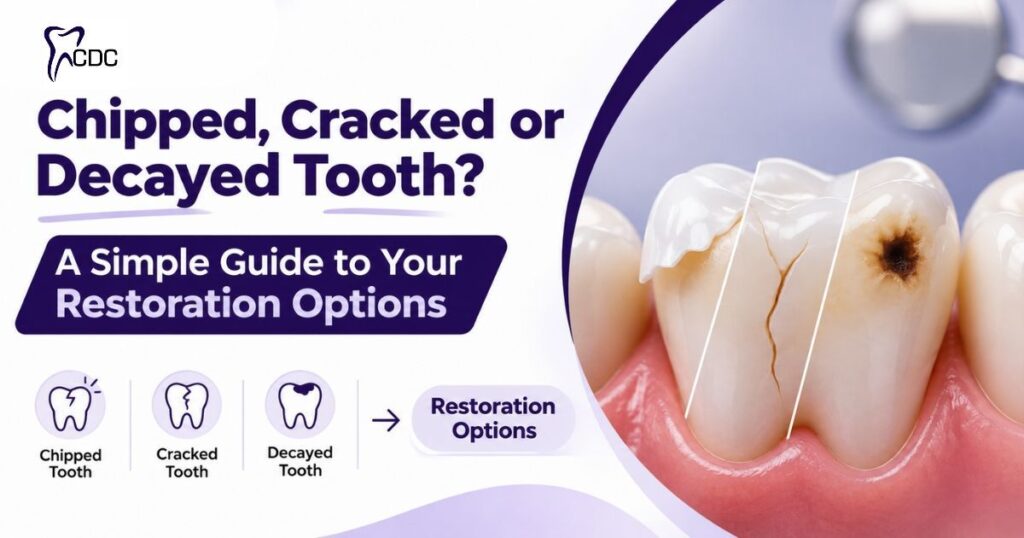
Chipped, Cracked or Decayed Tooth? A Simple Guide to Your Restoration Options
It usually starts small. A crunch on a popcorn kernel, a rough edge your tongue keeps finding, or a twinge every time you drink something cold. Most people hope it’ll settle down. Sometimes it does for a while. But a damaged tooth rarely fixes itself, and the right tooth restoration treatment depends on how deep the damage goes and whether the nerve is affected. So what are your options? Let’s go through them one by one. Which Tooth Restoration Treatment Is Right for a Chipped, Cracked or Decayed Tooth? Small chips are often fixed with bonding, and minor decay with a filling. Larger damage may need an inlay, onlay or crown. If decay or a crack reaches the nerve, root canal treatment usually comes first. A dentist decides after an examination and, often, an X-ray. Why Damaged Teeth Shouldn’t Wait Decay is far more common than most of us think. The World Health Organization lists untreated decay in permanent teeth as the most common health condition in the world. Oral diseases affect nearly 3.7 billion people. A small cavity can quietly grow until it reaches the nerve. By then, you may be dealing with pain or an infection. Caught early, tooth restoration treatment tends to be simpler, quicker and easier on your pocket. Dental Filling and Tooth Restoration for Decay Got a cavity? A filling is normally the first step. Your dentist cleans out the decayed part, then fills the gap so the tooth looks and works the way it should. Most fillings today are tooth-coloured composite, which is hard to spot once it’s in. Glass ionomer is sometimes used near the gum line. Silver amalgam? You’ll see it far less often now. Bigger cavities might call for an inlay or onlay instead. These are shaped to fit and cover more of the biting surface. In other words, dental filling and tooth restoration isn’t one fixed treatment. It ranges from a tiny repair to a much larger rebuild. Treatment for Broken Tooth: Chips and Cracks There isn’t one treatment for broken tooth damage that suits everyone. Size and depth make all the difference. A small chip off a front tooth can often be rebuilt with bonding, a tooth-coloured resin shaped to match. If a bigger piece has broken away, a crown may be the better choice, since it covers the whole tooth and lets you chew normally again. Cracks are harder to judge. A minor one may only need a crown. If it reaches the nerve, root canal treatment may be needed first. And when a crack runs well below the gum line, the tooth sometimes can’t be saved. When Root Canal Treatment Is Needed Inside each tooth is soft tissue called the pulp. Once decay or a crack gets that far, the pulp can become inflamed or infected. Pain that lingers, sensitivity to heat and swelling are common warning signs. Root canal therapy is a tooth restoration treatment that removes the damaged pulp, then cleans and seals the canals. Back teeth usually get a crown afterwards for extra protection. What If the Tooth Can’t Be Saved? Occasionally, no tooth restoration treatment will work, because too little healthy tooth is left. The tooth may then need to come out. An implant, bridge or denture can replace it. Signs You Should See a Dentist Soon Don’t wait for it to get worse. A sharp or broken edge is worth getting checked, and so is pain when you bite down. Sensitivity that hangs around after hot or cold food, swelling or a bad taste near one tooth are other clues. Severe pain, a swollen face or a fever? That needs urgent care. Save Your Smile Before a Small Problem Grows Teeth don’t repair themselves. The sooner a problem is looked at, the more of your natural tooth you’re likely to keep. The right tooth restoration treatment begins with a proper check-up and a clear, honest talk about what’s possible. Chetana’s Dental Clinic assesses each tooth and explains suitable options, from fillings to root canal treatment and implants. For anyone searching for a restorative dental clinic in Navi Mumbai, their restorative dentistry services page is a good place to start before you book a consultation. Frequently Asked Questions 1. Can a chipped tooth be fixed in one visit? Often, yes. A small chip can usually be repaired with bonding in a single appointment. A bigger break might need a crown, which can take more than one visit. Your dentist will tell you which suits you after examining it. 2. How long does a dental filling last? That depends on the material, how big the filling is and your habits. Plenty of fillings last for years with good care. Regular check-ups catch wear early, so any dental filling and tooth restoration work can be fixed in time. 3. Does tooth restoration treatment hurt? Most procedures use local anaesthetic, so you usually won’t feel pain while it’s being done. A bit of sensitivity afterwards is normal and tends to fade. Your dentist will explain what to expect from your tooth restoration treatment first. 4. What should I do if I break a tooth? Rinse with warm water and keep any broken pieces. Sugar-free gum or dental wax can cover a sharp edge for now. Then get treatment for broken tooth damage quickly, especially if there’s pain, bleeding or swelling. 5. Is a crown better than a filling? Not always. It depends on the tooth. Fillings suit small to medium damage, while crowns are usually advised when a tooth is badly broken, heavily filled already or weakened after root canal treatment and needs full cover.